Destiny is not a matter of chance and no child of coincidence.
Whittington
Lisa
Greenwood
A community built a future. A nation let it burn.
Little Africa on Fire
On May 31, 1921, students at Booker T. Washington High School in Tulsa, Oklahoma, were getting ready for their junior-senior prom. The dresses had been chosen. In the nearby Greenwood District, Black families ran businesses, practiced medicine, owned homes, filled churches, and built wealth in defiance of Jim Crow. Known as Black Wall Street, and to some as Little Africa, Greenwood was one of the most prosperous independent Black communities in the nation.
Within about 16 hours, a white mob had destroyed more than 35 blocks of it.
The assault came by land and by air. Armed attackers invaded homes, looted businesses, murdered residents, and set buildings ablaze. Eyewitnesses reported biplanes circling overhead, with gunfire and kerosene bombs falling from the sky. A photograph from that day carried a caption that said it plainly: “Little Africa on fire.”
Thousands were left homeless, and generations were dispossessed. For decades the massacre was suppressed and left out of American history books. The survivors kept telling it anyway.
Painting the Evidence
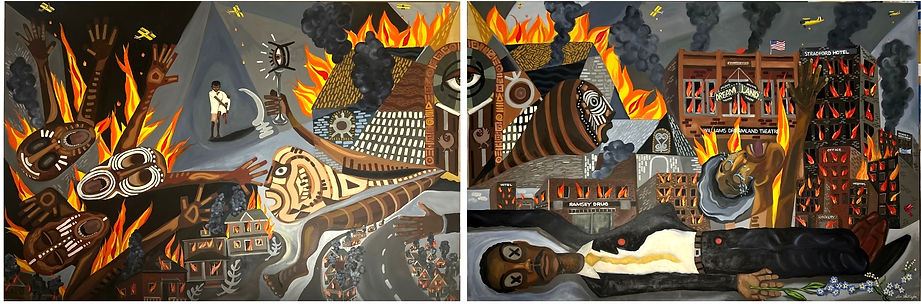
Lisa Whittington began Greenwood in 2021 during an artist residency at the Hambidge Center. The monumental diptych took five years of research, experimentation, and painting to complete.
Spanning twelve feet, it sets Greenwood’s two worlds side by side: the residential district on the left, the commercial district on the right. At the center, a burning church joins the panels, bound together by destruction. The buildings stand as witnesses. Biplanes rain fire from the sky. Adinkra symbols tie the composition to ancestral knowledge, survival, and direction. Every element has an assignment.
Dr. A. C. Jackson: The Responsibility of Remembrance
Among the figures is Dr. A. C. Jackson, a distinguished surgeon and one of the builders of Greenwood’s prosperity, murdered during the massacre. He stands for the excellence, leadership, and potential that racial violence destroyed.
In his hand, Whittington places forget-me-nots that reach beyond the picture plane toward the viewer. They are not only a memorial. They are a handoff. The work Jackson and his neighbors began, to build, educate, create, and protect what a community achieves, now passes to whoever stands before the painting.
The flowers are a request and a charge: Remember these people. Continue what they started.
Guernica and the Question of War
Whittington studied the history of war painting, especially Pablo Picasso’s Guernica (1937), his response to the bombing of a Basque town during the Spanish Civil War. She examined how artists use scale, fragmentation, symbolism, and abstraction to make terror visible.
That study raised a question America has never fully answered: What counts as an act of war, and who gets to decide?
Greenwood was not attacked by a foreign army. Its citizens were assaulted by fellow Americans, with armed men advancing through the streets and aircraft overhead. Whittington paints Greenwood in the tradition of monumental war painting, refusing the line drawn between atrocities on foreign battlefields and organized racial violence at home. Picasso bore witness to Guernica. Whittington bears witness to Greenwood.
One Greenwood. Many Others.
Greenwood is not only about Tulsa. Across American history, independent Black communities built schools, businesses, and economic power, only to face violence, dispossession, and deliberate destruction. Tulsa is one of many.
The painting refuses to let destruction be the only legacy. Its streets and storefronts testify to what existed before the fire. The flames expose what was taken. The figures, symbols, and flowers insist on the humanity of the people who built it all.
As a Steward of Memory, Whittington knows that preserving history means preserving more than the catastrophe. It means preserving the lives, ambitions, and prosperity that came before it, and asking what America lost when it allowed that destruction and then buried the story for generations.
The massacre lasted hours. Its consequences have lasted more than a century.
Greenwood is an act of remembrance, an indictment of racial terror, and a visual record.
History is not asleep. It is watching us.
